Featured Power Distribution & Switchgear Solutions
Precision-Engineered Low Voltage, Medium Voltage, and Intelligent Power Distribution Panels Certified for Mission-Critical Infrastructure
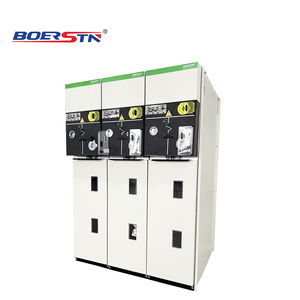
12kV–36kV Ring Main Unit (RMU) Switchgear Panel
Heavy-duty power distribution equipment featuring gas/solid insulated RMU switchgear, rated 630A to 2500A for medium voltage grid reliability.
Get a Quote
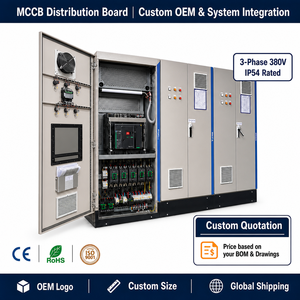
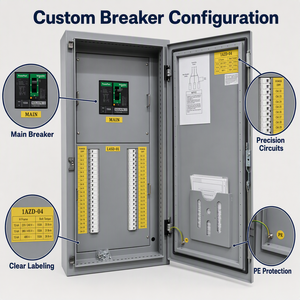
Low Voltage Switchgear MCCB Distribution Board
Industrial-grade low-voltage electrical panel cabinet integrated with high-breaking MCCB circuit protection and customizable busbar arrangements.
Get a Quote
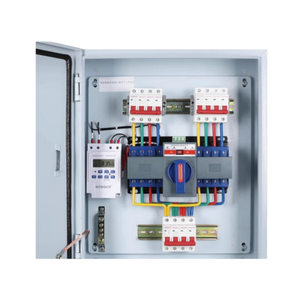
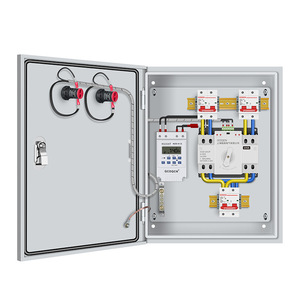
Dual Power Automatic Transfer Switch (ATS) Panel
Complete set automatic dual-power transfer cabinet featuring integrated timer controls, digital energy meters, and automatic failover switching.
Get a Quote
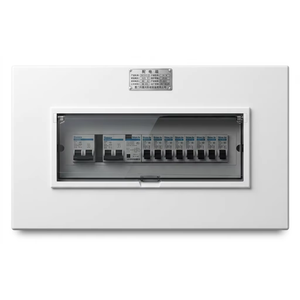
FXXM1 Flush Mount Residential Distribution Box
Compact indoor mini power panel rated 10A-32A (220V/380V, IP30) optimized for concealed residential wiring and local circuit isolation.
Get a Quote
Intelligent Dual Power ATS Cabinet with Energy Saver
Advanced ATS power distribution enclosure featuring digital timer metering, voltage stabilization, and smart power-saving circuitry.
Get a Quote
UL Listed 3-Phase 4-Wire Commercial Panelboard
380Y/220V heavy-duty industrial electrical panel engineered to rigid UL Listed standards for North American and global commercial facilities.
Get a Quote
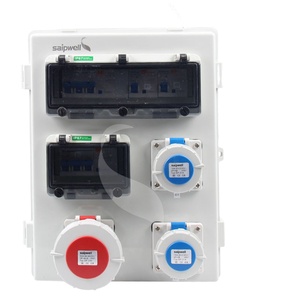
IP67 Waterproof Combined Socket Distribution Panel
Rugged plastic industrial control panel housing with combined power sockets and breaker windows designed for severe weather environments.
Get a Quote
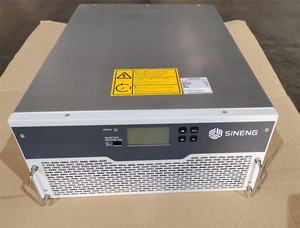
100A Active Harmonic Filter (APF) Industrial Panel
State-of-the-art 400V 10kvar/15kvar active harmonic compensation unit built in galvanized steel enclosure for power quality restoration.
Get a Quote
38+
Years Manufacturing Excellence
100%
ISO 9001 & UL Compliant
60+
Countries Export Footprint
99.999%
Mission-Critical Uptime
Engineering Authority: Evolution of Modern Distribution Panels & Switchgear
In modern industrial, commercial, and telecommunication infrastructure, the electrical distribution panel board is no longer merely a passive junction box housing fuses and mechanical switches. As global energy grids transition toward decentralized renewable generation, smart microgrids, and mission-critical data center deployments, power distribution architectures have evolved into sophisticated digital control hubs.
As a leading distribution panel manufacturer and factory, our engineering core centers on solving three key site vulnerabilities: thermal derating under continuous heavy load, harmonic distortion caused by non-linear industrial automation equipment, and catastrophic service interruptions. By integrating high-breaking capacity Molded Case Circuit Breakers (MCCB), intelligent Ring Main Units (RMU), active harmonic filtering (APF), and automated dual-power switching (ATS), our distribution enclosures guarantee continuous operational availability across harsh electrical environments.
Every panelboard engineered within our facilities adheres strictly to international electrical engineering standards (UL 67, IEC 61439, IEEE 519). We integrate direct busbar temperature monitoring, digital metering over Modbus/Ethernet, and live hot-swappable modularity to eliminate single-point operational failures.
Enterprise Advantage: Why Tier-1 Engineering Teams Specify Our Panels
Established on decades of high-reliability DC and AC power system engineering, our facility combines specialized North American design principles with high-capacity automated production lines. Unlike catalog resellers, we maintain 100% internal control over sheet metal fabrication, copper busbar machining, PCB assembly, and high-voltage dielectric testing.
Domestic R&D Precision matched with Global OEM Capacity
Our engineering teams work directly with electrical consultants, system integrators, and plant engineers to review single-line diagrams, load budgets, fault current calculations (KA ratings), and enclosure thermal dynamics before fabrication begins.
- Hot-Swap Modularity & N+1 Redundancy: Designed for live servicing without interrupting adjacent critical loads.
- Advanced Remote Telemetry: Embedded web-server control, SNMP alarm traps, and Ethernet remote load-shedding capabilities.
- Custom Busbar & Enclosure Metallurgy: 99.9% pure T2 electroplated copper busbars with high-grade galvanized steel or IP67 composite enclosures.
- Full Regulatory Traceability: Complete batch traceability, UL Listing verification, and factory acceptance test (FAT) documentation supplied with every shipment.
Global Procurement & Architectural Trends (2025–2035)
Procurement directors and chief electrical engineers face rapidly shifting grid dynamics. Understanding these technological macro-trends is crucial when specifying distribution equipment for long-term operational resilience:
1. Micro-Modular Switchgear & Gas/Solid-Insulated RMUs
As urban real estate costs surge and outdoor substations face harsher climate events, medium-voltage distribution is shifting rapidly toward compact 12kV, 24kV, and 36kV Ring Main Units (RMU). Gas-insulated (SF6-free clean air) and solid-insulated RMUs allow utilities and industrial parks to achieve maximum breaking capacity (up to 2500A / 31.5kA) within a footprint 60% smaller than legacy air-insulated switchgear.
2. Active Power Quality Management & Harmonic Compensation
The proliferation of Variable Frequency Drives (VFDs), industrial robotics, EV charging stations, and server power supplies introduces high-frequency harmonic distortion back into the supply transformer. Modern distribution panel procurement now routinely specifies Active Harmonic Filters (APF). By dynamically injecting counter-phase current, 100A APF panels eliminate 2nd to 50th order harmonics, stabilizing system power factor above 0.99 and eliminating utility financial penalties.
3. Dual-Power Automatic Transfer Switching (ATS) Integration
Grid instability and extreme weather events have elevated ATS units from optional accessories to core panel components. Modern ATS cabinets feature solid-state switching logic, sub-10ms transfer times, and integrated power-saving timers. This allows seamless failover between primary utility feeds, diesel backup generators, and local battery energy storage systems (BESS).
4. Intelligent IoT Telemetry & Remote Circuit Control
Unattended cell towers, edge data centers, and remote pumping stations cannot afford manual switch resets. Next-generation distribution panels integrate embedded web servers, IP-assigned control boards, and circuit-level current metering. Engineers can remotely monitor voltage drop, analyze real-time phase balance, and execute remote power-cycles via standard web browsers or centralized Network Management Systems (NMS).
Engineering Selection Matrix: Panelboard & Switchgear Specifications
Use the authoritative comparison table below to map site electrical requirements to the optimal enclosure, busbar architecture, and protection class:
| Panel Architecture |
Nominal Voltage |
Rated Current |
Protection Rating |
Primary Industrial Application |
Key Engineering Differentiator |
| Ring Main Unit (RMU) |
12kV – 36kV |
630A – 2500A |
IP65 / IP67 Metal-Clad |
Medium Voltage Grids, Solar Farms, Heavy Industrial Sites |
Gas/Solid Insulation, High Short-Circuit Breaking (up to 31.5kA) |
| Low Voltage MCCB Panel |
220V / 380V / 480V |
100A – 1250A |
IP30 / IP54 NEMA 12 |
Commercial Buildings, Factory Sub-Distribution Boards |
High-density MCCB modular slots, adjustable thermal-magnetic trips |
| Dual-Power ATS Cabinet |
110V – 415V 3-Phase |
63A – 800A |
IP54 / IP65 Cabinet |
Data Centers, Hospitals, Telecommunication Hubs |
Sub-10ms automatic load transfer, dual AC input isolation |
| Active Harmonic Filter (APF) |
400V (+/- 20%) |
50A – 150A (15kVAR) |
Galvanized Steel IP31 |
Automotive Plants, VFD-Heavy Manufacturing, Cleanrooms |
Dynamic 2nd-50th harmonic cancellation, real-time reactive power compensation |
| IP67 Outdoor Socket Box |
220V / 380V |
16A – 63A |
IP67 Waterproof |
Construction Sites, Outdoor Events, Mining Camps |
High-impact UV-stabilized polycarbonate enclosure, weatherproof socket windows |
| UL Listed 3-Phase Board |
380Y/220V, 480Y/277V |
100A – 400A |
NEMA 1 / UL Listed |
North American Commercial Facilities, Public Infrastructure |
Strict UL 67 listing compliance, standardized 3-phase 4-wire Wye buswork |
Proven Field Applications: Mission-Critical Deployments
Our distribution panels are engineered for zero-tolerance environments where site failure leads to severe financial or safety consequences.

Land Mobile Radio (LMR) & Public Safety
P25 mission-critical radio tower shelters equipped with redundant ATS panels, clean busbar distribution, and remote SNMP alarm telemetry to ensure 24/7 emergency dispatch communication.

Industrial Process Control & Utilities
Substation automation enclosures combining 100A APF active filters and heavy-duty MCCB panels to protect SCADA controllers against severe industrial power spikes.

Fiber Broadband & Telecom Huts
DIN-rail and rack-mounted distribution boards featuring intelligent low-voltage battery disconnect (LVBD) to prevent catastrophic battery drain during utility outages.
Procurement FAQ: Technical & Sourcing Guidelines
Direct answers from our Senior Application Engineering Team to common technical and OEM procurement queries:
Q1: What is the primary operational difference between Single Bus and Dual Bus distribution panels?
A single bus distribution panel routes electrical power from a single incoming main breaker to all branch circuit breakers. This provides a cost-effective, straightforward arrangement for standard facilities. Conversely, a dual bus panel contains two electrically isolated internal busbars (Feed A and Feed B). This architecture allows dual-corded critical equipment (e.g., enterprise servers, dual power supply switchgear) to draw from independent sources, enabling online maintenance on one bus without interrupting site operation.
Q2: How does an Active Harmonic Filter (APF) improve distribution panel longevity?
Non-linear loads generate current harmonics that cause transformer overheating, skin-effect losses in copper busbars, and nuisance breaker tripping. An Active Harmonic Filter monitors line current in real time via current transformers (CTs) and instantly generates inverse harmonic currents to cancel out distortion. Maintaining total harmonic distortion (THD) below 5% reduces busbar operating temperatures by up to 15°C and extends breaker lifespan significantly.
Q3: Why are UL Listed panelboards mandatory for North American commercial infrastructure?
UL 67 (Standard for Panelboards) mandates rigorous testing regarding short-circuit withstand ratings, dielectric withstand voltage, temperature rise under 100% rated continuous current, and mechanical safety enclosure integrity. Installing a non-UL listed electrical panel in North America violates National Electrical Code (NEC) regulations, voids commercial building insurance, and risks immediate site shutdown by local electrical inspectors.
Q4: What ingress protection rating is required for outdoor distribution boxes?
For exposed outdoor, coastal, or washdown environments, a minimum rating of IP65 is recommended to prevent dust infiltration and low-pressure water jets. For extreme environments subject to temporary immersion or heavy rainstorms, IP67 enclosure boxes featuring high-density silicone gaskets, UV-stabilized polycarbonate or stainless steel construction, and waterproof cable glands must be specified.
Q5: Can your factory manufacture custom OEM/ODM distribution panel configurations?
Yes. As a direct manufacturer and factory, we specialize in custom OEM engineering. We customize enclosure dimensions, knockout locations, sheet metal thickness (1.5mm–2.5mm cold-rolled steel), custom paint finishes (RAL color matching), busbar plating (tin or silver plated copper), brand labeling, and specialized digital meter integrations according to client project engineering drawings.
Q6: How does remote Ethernet monitoring integrate into existing plant SCADA systems?
Our intelligent panels feature an embedded Ethernet control interface supporting Modbus-TCP and SNMP v2c/v3 protocols. The system publishes live telemetry (voltage per phase, branch current, frequency, board temperature, and alarm status) directly to your existing building management system (BMS) or Network Operations Center (NOC) without requiring proprietary middleware.
Q7: What is the lead time for high-voltage Ring Main Units (RMU) and factory acceptance testing (FAT)?
Standard high-voltage RMU switchgear production lead times range from 4 to 6 weeks, depending on component availability and customization requirements. Standard factory acceptance testing (FAT) includes primary current injection, partial discharge insulation testing, high-voltage withstand testing, and functional secondary relay testing. Full FAT video reporting or client-attended testing is available prior to dispatch.
Consult Our Power Distribution Application Engineers
Submit your single-line electrical diagrams, technical load schedules, or OEM specifications. Our senior engineering team will deliver a comprehensive proposal, technical drawing, and factory-direct price quotation within 24 hours.