Industrial-Grade Energy Systems, Uninterruptible Power Supplies & Global OEM/ODM Solutions
Enterprise Product Lineup
Featured Mobile & Industrial Power Solutions
Standardized, high-reliability emergency power supplies, online UPS units, modular rectifiers, and commercial power banks designed for high-density power applications.
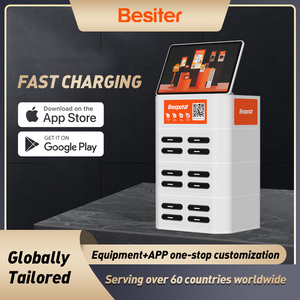
Besiter 12-Slot 22.5W Fast Charging Portable Power Rental Station 10.1" Screen Li-Polymer Battery
12 Hot-swappable slots with dynamic load balancing
22.5W High-Speed protocol output (PD/QC3.0)
10.1-inch interactive LCD for telemetry & advertising
Architectural Excellence in Mobile Power Manufacturing & Global Export
An in-depth technical evaluation of global DC power conversion, remote site resilience, lithium battery integration, and China's B2B supply chain infrastructure for system integrators and distributors.
Executive Overview: The Evolution of Industrial Mobile Power
In modern industrial and telecommunications operations, energy resilience is no longer an auxiliary requirement—it is a core operational imperative. As global power networks undergo rapid decentralization and mission-critical equipment is increasingly deployed in remote, off-grid, or harsh environments, the demand for high-reliability mobile power stations, uninterruptible power supplies (UPS), and modular DC conversion systems has surged. China’s manufacturing ecosystem has transitioned from high-volume assembly to advanced engineering, position-leading electrochemistry integration, and smart Ethernet telemetry.
This whitepaper examines the technical specifications, procurement trends, safety protocols, and manufacturing methodologies that define modern mobile power products. From low-latency 1-3KVA double-conversion online UPS systems to heavy-duty emergency field energy stations utilizing Lithium Iron Phosphate (LiFePO4) chemistry, enterprise procurement teams must navigate complex parameters including energy density, power conversion efficiency (PCE), thermal dissipation profiles, thermal runaway mitigation, and compliance with international standards such as UN38.3, UL1973, IEC 62133, and CE regulations.
97.4%
Peak Conversion Efficiency
3,500+
LiFePO4 Cycle Life (@80% DoD)
< 2ms
Transfer Time (Online Systems)
N+1
Hot-Swap Modular Redundancy
Global Sourcing & Procurement Trends for Mobile Power (2025–2030)
B2B energy procurement strategies are undergoing structural shifts driven by decarbonization mandates, total cost of ownership (TCO) optimization, and requirement for real-time asset tracking. Procurement directors sourcing from China factories are increasingly demanding standardized modular platforms over customized single-use power supplies. The following trends dominate global wholesale requirements:
1. Transition to High-Density LiFePO4 & Solid-State Systems
Traditional sealed lead-acid (SLA) batteries are rapidly being replaced by Lithium Iron Phosphate (LiFePO4) and emerging semi-solid-state architectures. LiFePO4 offers a 3x increase in volumetric energy density, over 3,500 charge cycles, superior thermal stability up to 60°C, and a dramatically lower lifetime TCO despite higher initial capital expenditure.
2. IoT Integration & Web Server Telemetry
Modern mobile power plants and rental stations now embed local HTML web servers, SNMP v2c/v3 capabilities, and cellular IoT gateways. Enterprise users no longer accept unmanaged black-box power supplies; they require circuit-level monitoring, remote load shedding, predictive fault notifications, and OTA firmware updates to prevent truck rolls.
To eliminate multiple power adapters across mobile communications, Land Mobile Radio (LMR), SCADA networks, and fixed wireless access (FWA) nodes, procurement trends favor multi-rail modular power shelves. A single enclosure can accept hot-swappable AC/DC rectifiers and DC-DC converters to feed 12VDC, 24VDC, and 48VDC buses simultaneously.
Product Engineering & Technological Development Roadmap
To maintain a competitive edge, elite OEMs and exporters in China are incorporating advanced wide-bandgap semiconductors (Gallium Nitride - GaN and Silicon Carbide - SiC) into power factor correction (PFC) stages and inverter topographies. This results in significant thermal reduction and system miniaturization.
Engineering Insight: Switching frequencies above 100 kHz enabled by GaN power transistors reduce passive magnetic component sizes by up to 40%, allowing 3KVA online UPS systems to be engineered into ultra-compact tower and 2U rack footprints while maintaining operating efficiencies above 96%.
Technical Matrix: Enterprise Mobile Power vs. Conventional Standby UPS
Architecture Type
Primary Energy Storage
Typical Efficiency
Transfer Time
Ideal Application Profile
Online Double Conversion UPS
LiFePO4 / High-Rate Lead-Acid
94% - 97%
0 ms (Instantaneous)
Data centers, critical IT, telecommunications nodes, medical equipment
As a premier China mobile power factory and global exporter, our manufacturing processes mirror top-tier aerospace and telecom standards. We provide full lifecycle traceable engineering—from printed circuit board assembly (PCBA) to environmental stress screening (ESS).
Automated SMT & Quality Assurance Pipeline
Our production facility incorporates fully automated Surface Mount Technology (SMT) lines equipped with 3D Solder Paste Inspection (SPI), Automated Optical Inspection (AOI), and X-Ray inspection for BGA component integrity. Every power supply undergoes 100% full-load thermal burn-in testing under elevated ambient conditions for 24 to 48 hours prior to packaging.
ISO 9001:2015 & ISO 14001 certified manufacturing facilities
In-house EMC/EMI compliance testing chambers
Custom enclosure fabrication (IP54 outdoor rated, NEMA cabinets)
Full OEM/ODM Customization & Engineering Support
We work directly with system integrators, public safety organizations, and global brand distributors to deliver specialized firmware algorithms, customizable SNMP MIB files, private label chassis designs, and bespoke voltage setpoints. Our application engineering team evaluates your single-line diagrams and load budgets before mass production.
Custom mechanical rack-mount, tower, and DIN-rail forms
Multi-language LCD interface & app development
Global shipping compliance (UN38.3, MSDS, Sea/Air Freight certifications)
Procurement Knowledge Base
Frequently Asked Questions for Wholesale Mobile Power Sourcing
Direct technical answers to common queries raised by international buyers, procurement officers, and engineering integrators.
What are the critical compliance certifications required for importing mobile power stations and UPS systems from China?
International importation requires compliance with both electrical safety and battery transport standards. For energy storage and mobile power supplies, key certifications include UN38.3 (transport safety testing for lithium batteries), MSDS (Material Safety Data Sheets), and transport certificates for sea/air freight. Electrical safety requires CE (EN 62368-1 for IT equipment, EN 62040 for UPS systems), FCC Part 15 Class A/B for electromagnetic compatibility, and UL 1973 or UL 2743 for North American markets.
How does your factory prevent thermal runaway in high-capacity LiFePO4 mobile power supplies?
Thermal management is enforced at three structural levels: First, cell level—using prismatic or cylindrical LiFePO4 chemistry with inherently safe thermal runaway thresholds (>270°C). Second, hardware BMS level—integrated Smart BMS circuits provide real-time monitoring of individual cell voltages, current shunt monitoring, and multi-point NTC temperature sensors that cut off charge/discharge if temperatures exceed 55°C. Third, physical enclosure level—isolated thermal compartments with internal fire-retardant barriers and variable-speed cooling fans that scale airflow according to internal power dissipation.
Can your online UPS and DC power systems be configured for N+1 modular redundancy?
Yes. Our industrial DC shelves and modular UPS systems accept multiple hot-swappable rectifier or inverter modules operating in active current-sharing mode. By adding one module beyond your calculated peak load requirement (N+1), the system guarantees zero interruption if a single module fails. Hot-swappable architecture allows field technicians to exchange a faulty module while the system remains continuously energized.
What is the difference between single bus and dual bus DC power distribution in telecommunication backup systems?
A single bus panel feeds all output circuits from a single unified DC source or battery bank, maximizing wiring simplicity. A dual bus panel incorporates two electrically isolated distribution buses inside a single chassis. This allows system engineers to split critical loads between Independent Feed A and Feed B, or operate two distinct voltage rails (e.g., -48VDC and +24VDC) while monitoring telemetry for both buses independently over a single Ethernet SNMP interface.
What customization options (OEM/ODM) are supported for wholesale volume orders?
We offer comprehensive OEM/ODM services including custom metal housing dimensions, private-label branding, customized color schemes, localized AC socket configurations (US, EU, UK, AU, Universal), custom LCD screen GUI design, customized BMS voltage cutoff points, and specialized communication protocols (Modbus RS485, CANbus, SNMP v3, MQTT for IoT platforms).
How do you handle warranty support and spare parts logistics for international importers?
All enterprise products come with a standard 24 to 36-month factory warranty. For global distributor partners, we provide 1% to 2% complimentary spare parts (including power modules, main control boards, and cooling fan assemblies) with volume container shipments, along with component-level schematic documentation and direct remote technical support from our application engineers.
Partner with a Leading China Mobile Power Manufacturer
Need custom factory pricing, detailed engineering datasheets, or OEM/ODM project assistance? Our application engineering team is ready to analyze your power specifications.